
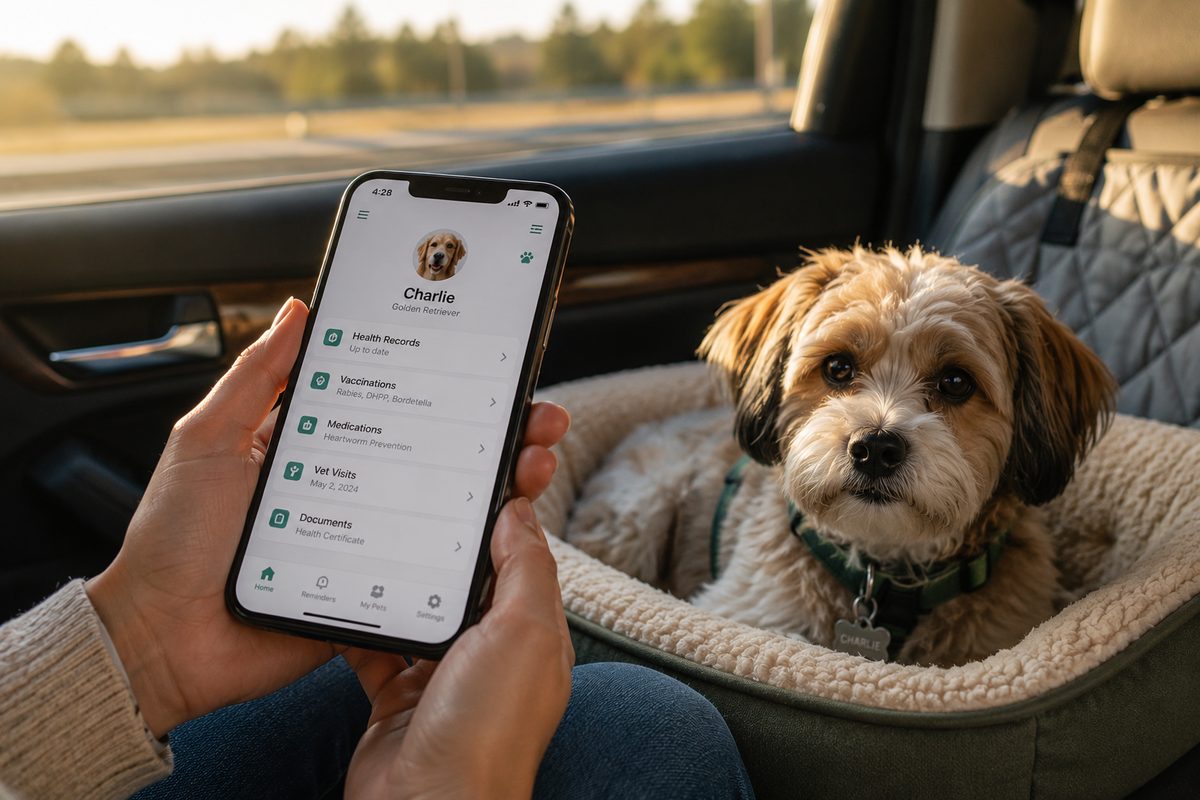
Most people don't think about their pet's medical records until the exact moment they need them — usually at an unfamiliar vet's front desk, mid-trip, trying to remember the name of a medication while everyone's stressed and the dog won't stop pacing. Travel is when gaps in your record-keeping actually cost you. Here's how to close them before they matter.
At home, with one regular vet, memory mostly works. You see the same clinic, they have your history on file, and a gap in your own recollection gets filled in by their records. Travel removes that safety net entirely. A new vet in a new city has none of your pet's history — and you're the only source of truth they've got, often while distracted, jet-lagged, or mid-emergency.
Paper records don't fully solve this either. They get left in a glove compartment, soaked by a spilled water bottle, or simply forgotten in the rush of getting out the door.
Most travel health-record advice focuses on the documents you need to get into a country or onto a flight. But the more common real-world situation is simpler and scarier: your pet gets sick or hurt mid-trip, and you're standing in a vet's office you've never been to, in a city you don't live in, being asked questions you can't fully answer from memory.
This is the actual moment good record-keeping pays off — not the airport, the emergency room.
Paper has one advantage: it works without a charged phone or signal. But it has real weaknesses on the road — it's easy to lose, impossible to update on the fly, and only exists in one place at a time. A digital record you can pull up on your phone solves the access problem, as long as you've got something that works offline too, since "find a vet's office Wi-Fi" shouldn't be step one of an emergency.
YourPetPass keeps every vaccine, medication, and vet visit in one place — ready to show a new vet the moment you need to, even off-grid.
Try YourPetPass Free →