
Pet Travel
APHIS Form 7001 vs. a Country-Specific Pet Health Certificate
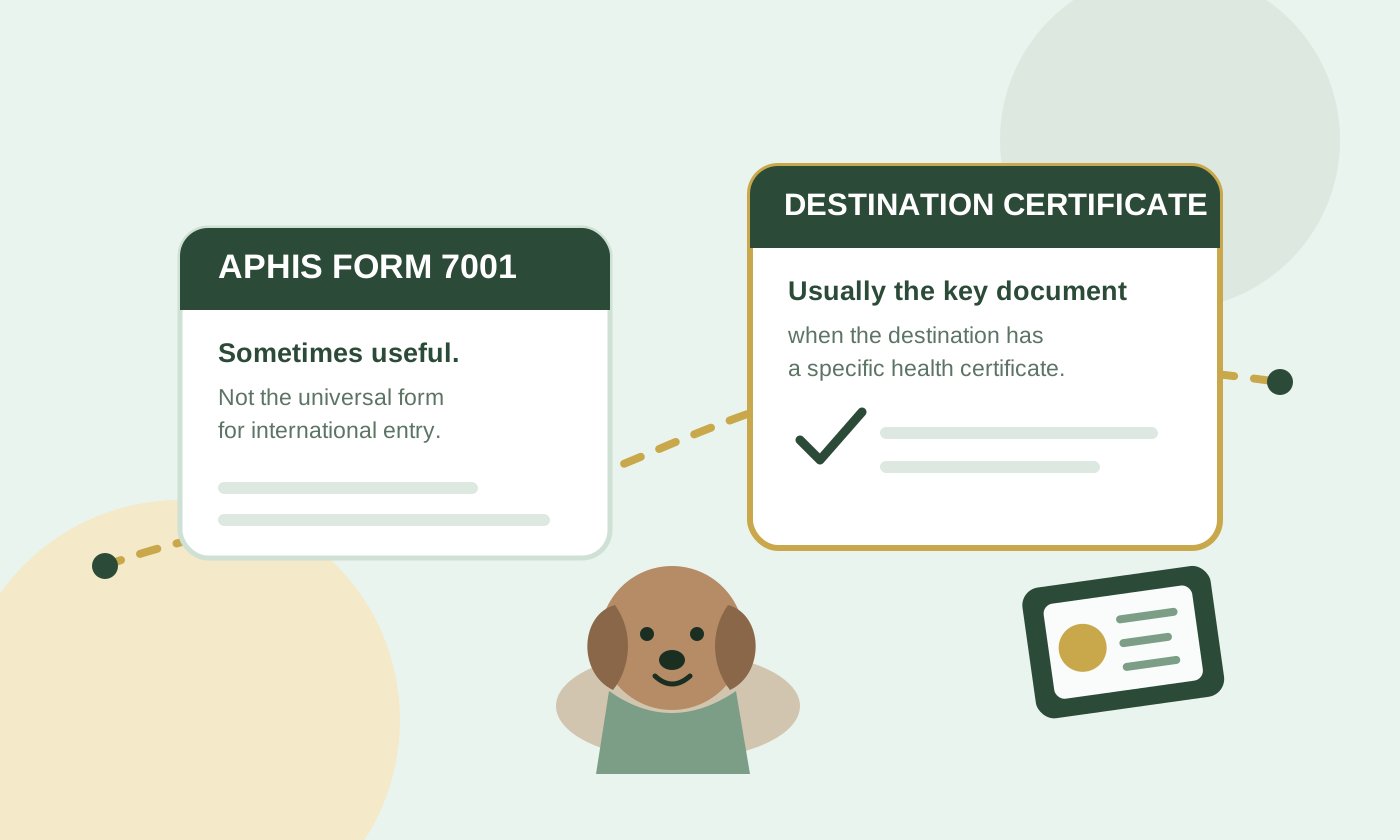
APHIS Form 7001 is a real veterinary health certificate, but it is not the universal form for taking a pet abroad. When a destination has its own required health certificate, that destination-specific document normally takes priority—and USDA says it is the certificate APHIS can endorse.
The short answer
- There is no single health certificate that works for every country.
- If USDA APHIS lists a country-specific health certificate for your destination, use that certificate for the destination's entry process.
- USDA says APHIS can endorse the destination-specific certificate when one is required; it generally will not endorse Form 7001 instead.
- Form 7001 can still be useful in limited situations, including some airline paperwork scenarios or when destination requirements are not available through APHIS.
- Always separate three questions: what the destination government requires, what USDA requires for U.S. export endorsement, and what the carrier requires for transport.
Direct answer: APHIS Form 7001—the Interstate and International Certificate of Health Examination for Small Animals—is not a universal international pet passport or default export certificate. USDA's current guidance says that when a country-specific health certificate is available for the destination, that is the certificate the pet needs for entry and the certificate APHIS can endorse.
That distinction matters because travelers sometimes hear “get a 7001” as shorthand for “get a health certificate.” Those are not always the same instruction.
What is APHIS Form 7001?
APHIS Form 7001 is officially titled the United States Interstate and International Certificate of Health Examination for Small Animals. It records veterinary examination information and can document items such as the animal's identification, vaccination history and health status.
But its broad title can be misleading. USDA APHIS states that there is not one standard health certificate for all countries. Each destination sets its own import requirements, and many destinations use a specific export health certificate negotiated or accepted for pets traveling from the United States.
When a country-specific certificate takes priority
USDA's FAQ for accredited veterinarians is explicit: if a country-specific health certificate is available on the APHIS pet travel pages, that is the only health certificate the pet needs to enter the destination and the only health certificate APHIS can endorse for that destination.
The destination-specific form may include declarations, testing details, treatment language, identification fields or timing rules that do not appear on Form 7001. Those details are not administrative trivia; they are part of the importing country's entry conditions.
| Document | Main role | When it matters |
|---|---|---|
| Destination-specific international health certificate | Shows compliance with the importing country's pet-entry requirements. | Use it when the destination requires or provides one; this is generally the certificate USDA endorses. |
| APHIS Form 7001 | General certificate of health examination for small animals. | May be used in limited destination, unknown-requirement, or carrier-related situations. |
| Supporting records | Prove facts behind the certificate. | Rabies certificates, laboratory results, microchip records, permits or treatment records may be required depending on the route. |
When might Form 7001 still be used?
1. The carrier asks for separate health paperwork
USDA notes that a carrier may have requirements separate from the destination country's entry rules. If the carrier requires a health certificate in addition to the destination-specific document, a veterinarian may issue the carrier's form. If the carrier does not specify a particular form, USDA says Form 7001 may be used for boarding purposes.
That does not turn Form 7001 into the destination's entry certificate. It remains a separate transport-document layer.
2. APHIS does not have official destination requirements on file
When USDA has not been officially informed of a destination's pet-entry requirements, APHIS recommends contacting the destination country's animal-health authority. If requirements still cannot be obtained, USDA says a health certificate such as Form 7001 may be used as a fallback and strongly suggests that it be issued by a USDA-accredited veterinarian and endorsed by APHIS.
This is a fallback for uncertainty—not proof that Form 7001 satisfies an importing country's unpublished or changing rules.
1. Check the destination government's current pet-entry rules.
2. Check USDA APHIS guidance for travel from the United States to that destination.
3. Use the exact destination certificate specified.
4. Separately check the carrier's transport-document requirements.
5. Treat Form 7001 as an additional or fallback form only when the official instructions support using it.
Free to start — organize your pet's travel documents →
Why using the wrong form can create problems
A beautifully completed certificate is still the wrong document if the destination requires a different one. USDA warns veterinarians not to issue an international health certificate until the destination requirements are met, and incomplete or incorrect submissions can delay USDA endorsement.
The practical risks are straightforward:
- Your veterinarian may need to redo the certificate on the correct form.
- USDA may be unable to endorse the document you submitted.
- You can lose time inside a narrow pre-travel certificate-validity window.
- A carrier may accept paperwork that the destination authority does not accept—or vice versa.
- Mismatched microchip numbers, vaccination dates or owner details can force corrections late in the process.
For the endorsement stage itself, see USDA Pet Health Certificate Endorsement: What VEHCS Means for Pet Owners. If you are preparing for the appointment, use our USDA-accredited vet appointment checklist.
A practical pre-appointment checklist
Before your veterinarian starts filling out any international certificate, confirm the following:
- Exact destination country and any transit countries
- Species, breed, sex, age and identifying details
- Microchip number and implantation/read date if the destination requires it
- Rabies vaccination certificate and any other required vaccines
- Required laboratory results and collection dates
- Required parasite-treatment records and timing
- Import permit, if the destination requires one
- The exact destination-specific certificate version currently required
- Whether USDA endorsement is required
- Whether the carrier wants a separate health form
Form 7001 is not the same as USDA endorsement
Another common source of confusion is treating the form and the endorsement as the same thing. They are separate concepts.
A USDA-accredited veterinarian issues the health certificate after confirming the relevant requirements. If the destination requires federal endorsement, USDA APHIS then reviews and endorses the appropriate export health certificate. For many destinations, that workflow can be submitted electronically through VEHCS.
USDA specifically says that when a destination-specific certificate is required, APHIS can only endorse that destination-specific certificate—not an extra Form 7001 created solely for carrier use.
FAQ
Is APHIS Form 7001 required for every international pet trip?
No. USDA says there is no single standard health certificate for every country. The destination's current requirements determine which certificate is needed.
If I already have Form 7001, do I still need the destination-specific certificate?
If the destination requires a specific certificate, yes. Form 7001 does not replace that destination-specific document simply because a veterinarian completed it.
Can USDA endorse Form 7001?
Sometimes, but not as a substitute when the destination requires a country-specific certificate. USDA says the destination-specific certificate is the one APHIS can endorse in that situation.
Why would my veterinarian complete two health certificates?
One may be the destination's official international health certificate, while another may satisfy a separate carrier requirement. USDA treats destination-entry requirements and carrier transport requirements as different layers.
What if USDA does not list requirements for my destination?
Contact the destination country's animal-health authority. USDA says that if requirements cannot be obtained, a health certificate such as Form 7001 may be used as a fallback, but that does not guarantee the destination will accept it.
Should I use an airline website to decide what the destination country requires?
No. Carrier rules are useful for boarding requirements, but destination-country entry rules should be verified with the responsible government authority and official export guidance.
Primary sources
This guide was checked against current USDA APHIS primary guidance on September 10, 2026.
Your pet's health history belongs with you.
Keep vaccination records, medical history and travel documents organized before the certificate clock starts. One app for every trip and every vet visit.
Create your free YourPetPass account →